How do I add Orshot Embed to my app?
Add Orshot Embed to your app with one iframe, in React, Vue, Angular or plain HTML. Allowlist your domains, then open a set template or language by URL.
Updated
Add the editor to any page with an iframe, or with the React and Vue components. This page covers the snippet, the URL parameters and security.
Quick Start#
1. Get Your Embed Code#
After configuring your embed settings, copy the generated embed HTML:
<iframe src="https://orshot.com/embeds/abc123def" title="Orshot Embed" allow="clipboard-write" style="width: 100%; height: 600px; border: none; border-radius: 8px;"></iframe>Grab it from the Embed Code tab in your embed settings. It gives you the basic snippet, plus variants that open a specific template or language:
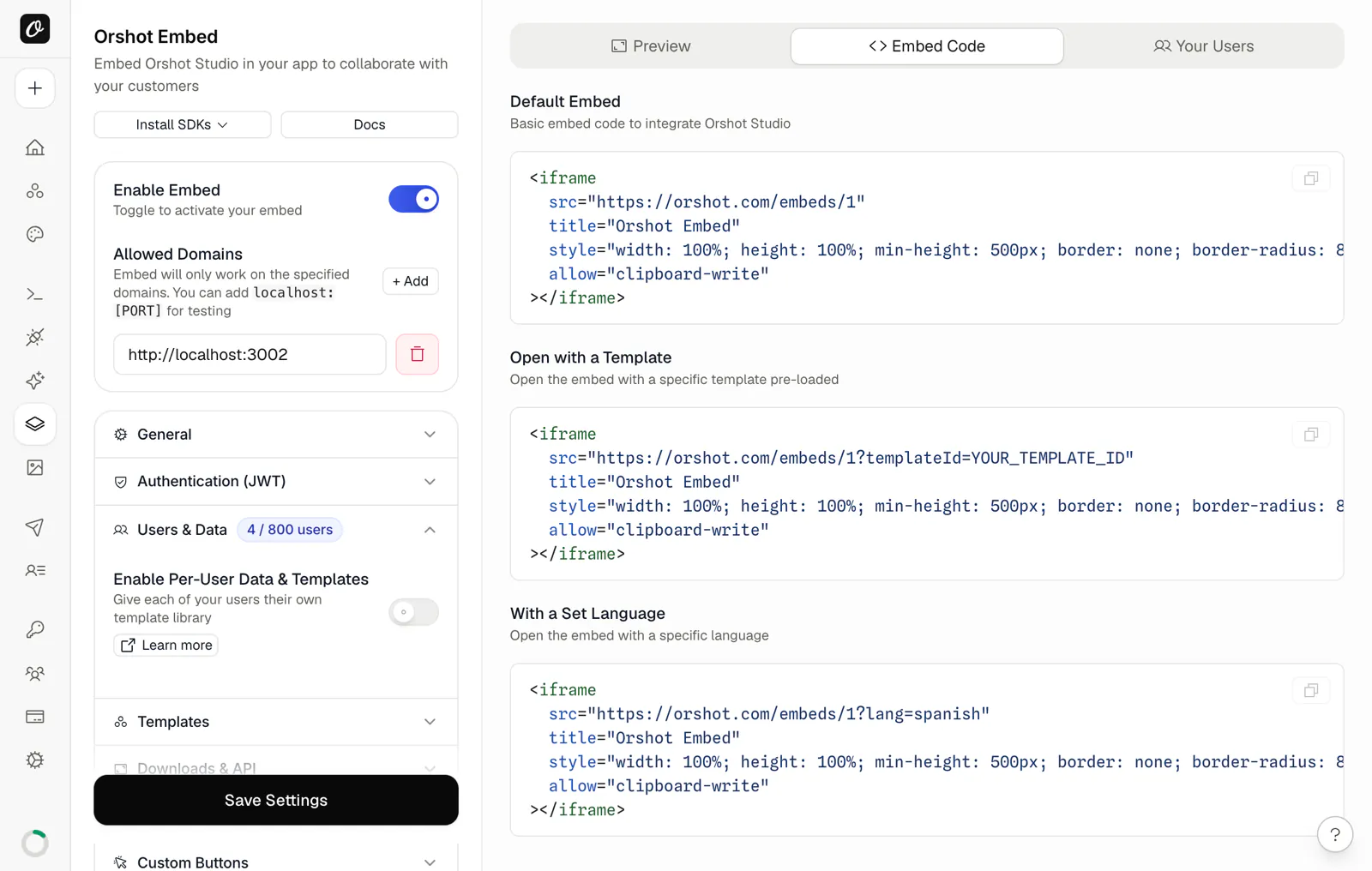
2. Add to Your App#
Paste the embed code where you want the design interface to appear:
<div class="design-editor">
  <iframe
    src="https://orshot.com/embeds/abc123def"
    title="Orshot Embed"
    allow="clipboard-write"
    style="width: 100%; height: 600px; border: none; border-radius: 8px;"
  ></iframe>
</div>
3. Style the Container#
Make sure your embed has proper dimensions:
.design-editor {
  width: 100%;
  min-height: 600px;
  max-height: 80vh;
  border-radius: 12px;
  overflow: hidden;
  box-shadow: 0 4px 6px -1px rgba(0, 0, 0, 0.1);
}
Framework Examples#
React/Next.js#
export function DesignEditor({ templateId }) {
  const embedUrl = templateId
    ? `https://orshot.com/embeds/abc123def?templateId=${templateId}`
    : `https://orshot.com/embeds/abc123def`;

  return (
    <div className="w-full h-[600px] rounded-lg overflow-hidden">
      <iframe src={embedUrl} title="Orshot Embed" allow="clipboard-write" className="w-full h-full border-none" />
    </div>
  );
}Vue.js#
<template>
  <div class="design-editor">
    <iframe :src="embedUrl" title="Orshot Embed" allow="clipboard-write" class="w-full h-full border-none"></iframe>
  </div>
</template>

<script>
export default {
  props: ["templateId"],
  computed: {
    embedUrl() {
      const base = "https://orshot.com/embeds/abc123def";
      return this.templateId ? `${base}?templateId=${this.templateId}` : base;
    },
  },
};
</script>Angular#
import { Component, Input } from "@angular/core";

@Component({
  selector: "app-design-editor",
  template: `
    <div class="design-editor">
      <iframe [src]="embedUrl" title="Orshot Embed" allow="clipboard-write" class="w-full h-full border-none"></iframe>
    </div>
  `,
})
export class DesignEditorComponent {
  @Input() templateId?: string;

  get embedUrl() {
    const base = "https://orshot.com/embeds/abc123def";
    return this.templateId ? `${base}?templateId=${this.templateId}` : base;
  }
}
URL Parameters#
templateId#
Open with a specific template:
?templateId=123lang#
Open the embed in a set language. This overrides the default language in your embed settings:
?lang=spanishThe lang parameter takes one of these 7 language ids:
lang value | Language |
|---|---|
english | English |
portuguese | Português |
spanish | Español |
french | Français |
german | Deutsch |
russian | Русский |
greek | Ελληνικά |
Without lang, the embed opens in the Default Language set in your embed configuration, or English if none is set.
Combined Parameters#
Use multiple parameters together:
?templateId=123&lang=frenchResponsive Design#
Make your embed work on all screen sizes:
.design-editor {
  width: 100%;
  height: 70vh;
  min-height: 500px;
  max-height: 800px;
}

@media (max-width: 768px) {
  .design-editor {
    height: 60vh;
    min-height: 400px;
  }
}

@media (max-width: 480px) {
  .design-editor {
    height: 50vh;
    min-height: 350px;
  }
}
Error Handling#
Domain Restrictions#
If users see a domain error, check your allowed domains list:
// Add your domains in embed settings
const allowedDomains = [
  "https://yourapp.com",
  "https://staging.yourapp.com",
  "http://localhost:3000", // for development
];
Loading States#
Show a loading indicator while the embed loads:
function DesignEditor() {
  const [isLoading, setIsLoading] = useState(true);

  return (
    <div className="relative">
      {isLoading && (
        <div className="absolute inset-0 flex items-center justify-center bg-gray-50 rounded-lg">
          <div className="text-gray-500">Loading design editor...</div>
        </div>
      )}
      <iframe
        src="https://orshot.com/embeds/abc123def"
        title="Orshot Embed"
        allow="clipboard-write"
        onLoad={() => setIsLoading(false)}
        className="w-full h-[600px] border-none rounded-lg"
      />
    </div>
  );
}
Security Best Practices#
Content Security Policy#
Add the embed domain to your CSP:
Content-Security-Policy: frame-src 'self' https://orshot.com;Domain Validation#
Always configure allowed domains in your embed settings. Never leave this empty in production.
HTTPS Only#
Always use HTTPS URLs for production embeds.
Performance Tips#
Lazy Loading#
Load embeds only when needed:
import { useState, useRef, useEffect } from "react";

function LazyDesignEditor() {
  const [shouldLoad, setShouldLoad] = useState(false);
  const containerRef = useRef();

  useEffect(() => {
    const observer = new IntersectionObserver(([entry]) => {
      if (entry.isIntersecting) {
        setShouldLoad(true);
        observer.disconnect();
      }
    });

    if (containerRef.current) {
      observer.observe(containerRef.current);
    }

    return () => observer.disconnect();
  }, []);

  return (
    <div ref={containerRef} className="h-[600px]">
      {shouldLoad ? (
        <iframe src="https://orshot.com/embeds/abc123def" title="Orshot Embed" allow="clipboard-write" style={{width: '100%', height: '100%', border: 'none'}} />
      ) : (
        <div className="flex items-center justify-center h-full bg-gray-50">
          <div>Click to load design editor</div>
        </div>
      )}
    </div>
  );
}Preloading#
For better user experience, preload the embed:
<link rel="preload" href="https://orshot.com/embeds/abc123def" as="document" />Common Issues#
Embed Not Loading#
- Check if embed is enabled in settings
- Verify the embed ID is correct
- Ensure your domain is in the allowed list
Permission Errors#
- Check workspace permissions
- Verify user roles and access
- Review embed configuration settings
Styling Issues#
- Ensure proper container dimensions
- Check for CSS conflicts
- Verify responsive breakpoints
Testing#
Development#
Use localhost in your allowed domains:
http://localhost:3000
http://localhost:8080Staging#
Test with your staging domain before production:
https://staging.yourapp.comProduction#
Always test the full user flow in your production environment before launch.
Ready to automate?
Start rendering images, PDFs and videos from your templates in under 2 minutes. Free plan, no credit card.
Get your API key- Image, PDF and video generation via API
- Visual editor with AI and smart layouts
- Zapier, Make, MCP and 40+ integrations
- White-label embed for your own app
- 100 free credits a month, no credit card required